FOR IMMEDIATE RELEASE
Comprehensive assessment finds LNG Canada, Coastal GasLink and upstream natural gas development have advanced economic growth, Indigenous partnership, environmental performance and community well-being
VANCOUVER, B.C. — 25 June 2026 — Energy for A Secure Future today released a major new report examining the economic, social and community impacts of LNG Canada, Coastal GasLink and the upstream natural gas sector across British Columbia’s LNG corridor, concluding that the projects have generated important benefits for workers, Indigenous Nations, local communities and governments while establishing a foundation for future growth.
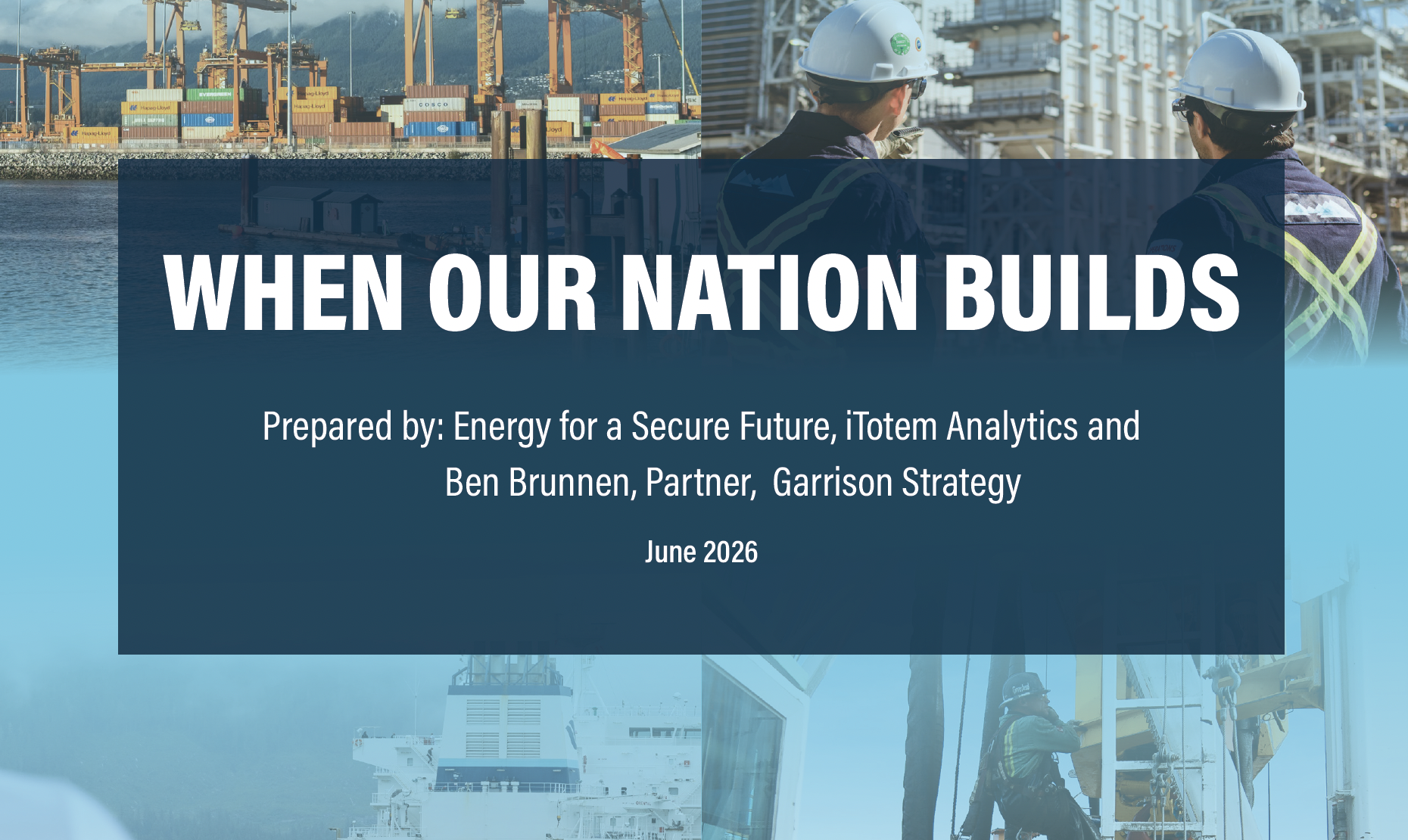
The report, When Our Nation Builds, evaluates the performance of LNG Canada and Coastal GasLink against British Columbia’s five conditions for LNG development and examines how project-related investments are influencing long-term community well-being across northern British Columbia.
The analysis finds that the projects have supported tens of thousands of jobs, generated billions in economic activity, expanded Indigenous participation in major resource development, contributed to public revenues, and strengthened local capacity through investments in education, housing, healthcare, workforce development and cultural programming.
Social Progress Modelling compares key indicators in 2021 and 2031 including household income, completion of post-secondary education, and knowledge of Indigenous language. It shows not only that it was worth it for communities to have supported LNG Canada Phase I and Coastal GasLink, but that the completion of other projects in the region, including Cedar LNG, LNG Canada Phase II and Ksi Lisims LNG, would materially improve the economic and social trajectory of communities in the region.
“Large-scale projects are often evaluated by GDP impacts, but equally important is how they benefit communities locally. This report finds that LNG Canada and Coastal GasLink have not only delivered major economic benefits but have also helped strengthen the social foundations of communities across the corridor through workforce development, Indigenous partnership, community investment and long-term capacity building. Saying ‘yes’ has changed the trajectory of the region for the better.”
– Shannon Joseph, Chair for Energy for A Secure Future.
“Many First Nations in northern B.C., including my own, took a chance on the Coastal GasLink project, despite national controversy. Today, my Nation, alongside the others on the pipeline route, have a share and a say in major infrastructure running through our homelands. It was not an easy road but it has given us new possibilities for self-determination and for partnerships that benefit Canadians and the world.”
– Karen Ogen, CEO, First Nations Natural Gas Alliance
“One of the most important findings is that these projects demonstrate how economic development, environmental responsibility, Indigenous partnership and community well-being can reinforce one another and build confidence for investment, including by companies like Tenaris. We see the commitment of industry and we are prepared to be part of the long-term success of LNG in Canada.”
– Martin Castro, President, Tenaris Canada
“High quality, high-paying union jobs are one of the foundations for quality of life for Canadians. LNG Canada Phase I and Coastal GasLink provided both, along with training opportunities that have already created long-term value for workers who now have the skills to accelerate Canada’s path to be an energy superpower. Our workers are proud of the role we played in building these projects and look forward to the next phase.”
– Sean Strickland, Executive Director, Canada’s Building Trades Union
“This report confirms what we already know – that major energy projects like LNG Canada and Coastal GasLink create thousands of good jobs and generate billions in revenue that supports better public services. They also deliver some of the lowest carbon LNG in the world. These projects lift all boats, generating economic growth that’s shared by everyone in B.C. Through our Look West strategy, $88 billion in proposed major projects over the next three years are expected to deliver more of these benefits and tens of thousands of new jobs. This is our moment. This is how we create long-term prosperity that benefits all British Columbians and fund the public services we need.”
– David Eby, Premier of British Columbia
“In 2018 our government put conditions in place to ensure that benefits from LNG projects would flow to people and communities. This report shows that’s exactly what has happened: tens of thousands of family-supporting jobs created, billions of dollars in provincial revenues supporting healthcare, education and other services, investments and partnerships that are bringing benefits to First Nations and communities, and advances in the environmental performance of natural gas production. All of these and more have been possible thanks to our efforts with First Nations and industry to unlock the value of our natural resources.”
– Adrian Dix, B.C. Minister of Energy and Climate Solution
Key Findings
Part 1: Canada Has Important Advantages as an LNG Exporter
Canada has world class natural gas resources in its Montney basin that are economically and environmentally efficient to produce. Moreover, our proximity to Asian energy markets, free of geopolitical chokepoints, makes Canada an ideal supplier to reliably meet growing energy demand.
Part 2: LNG Canada Phase I and Coastal Gaslink Pipeline Created Value Nationally and for Local Communities
LNG Canada Phase I and Coastal GasLink Pipeline were developed with the B.C. Five Conditions at the forefront: (1) Opportunities for British Columbians, jobs and training; (2) Fair return for B.C. resources; (3) Respect and make partners of First Nations; (4) Protect B.C.’s air, land, water and including its climate commitments; (5) Demonstrate benefits to communities.
Important local outcomes include:
- More than 50,000 Canadians contributed to the construction of LNG Canada Phase I, while Coastal GasLink supported over 25,700 full-time equivalent jobs in British Columbia.
- LNG development is projected to generate approximately $23 billion in government revenues over 40 years, while LNG Canada is expected to contribute approximately $15 million annually in municipal and regional taxes.
- Between 2019 and 2023, own-source revenues among First Nations in the project corridor increased by 159 per cent, enabling greater investment in community priorities including education, infrastructure and cultural programs.
- LNG Canada is expected to operate at an emissions intensity approximately 35 per cent below top-performing global LNG facilities and roughly 60 per cent below the global industry average.
- Community indicators have improved during the project period, including a 34 per cent increase in after-tax household income, a 19 per cent increase in registered nurses per capita and rising school completion rates.
Part 3: Evidence of a New Trajectory in Community Progress
While many communities in the project area had solid social indicators, including employment and housing affordability, relative to provincial averages, they also faced notable gaps including lower post-secondary attainment rates, slower income growth and declining Indigenous language knowledge.
To understand the benefits of LNG projects to the region a social progress model was used to evaluate how trajectories across key social indicators evolve across three scenarios from 2021 to 2031: (1) with no LNG projects, (2) with LNG Canada Phase I and Coastal GasLink, and finally (3) with LNG Canada and Coastal GasLink, as well as Cedar, Ksi Lisims LNG and LNG Canada Phase II.
The analysis shows that in 2031:
- In 2031, average household income in corridor communities is projected to reach $152,000 with LNG Canada and Coastal GasLink and $159,000 with the addition of Phase II projects, compared with $133,000 in a No Project scenario.
- In the Phase II Scenario, approximately 5,500 additional households are projected to achieve housing affordability in 2031, while up to 6,630 additional residents would obtain trade, vocational or university credentials.
- With the Project and Phase II Scenario, Indigenous language knowledge is projected to increase, compared to baseline and the No Project scenario, reversing previous declines and supporting an important long-term cultural goal across participating communities.
Part 4: Canada’s Upstream Natural Gas is the Driver of the LNG Industry and New Prosperity
- Growth in Canadian LNG exports is expected to drive substantial future production increases where natural gas production is forecast to increase from about 19 billion cubic feet per day (bcf/d) in 2025 to 25 bcf/d by 2030. B.C. production is projected to rise from approximately 7.5 bcf/d to 12 bcf/d by 2030.
- Indigenous participation in the upstream natural gas industry is significant and include royalty revenue-sharing agreements with the province, supply chain participation – upstream companies spent an estimated $162 million with Indigenous suppliers in 2025 – and other contracting, including approximately 85 Indigenous businesses engaged in service and procurement contracts.
- Environmental performance in the upstream natural gas sector has improved faster than production growth due to improvements to methane reduction programs, equipment upgrades, electrification, and operational efficiencies. Since 2014, natural gas production has increased by 61%, while:
- Total upstream emissions have declined by 24%.
- Methane emissions have fallen by 51%.
- Emissions intensity decreased by 53%.
- Supports to local communities include food banks, schools, libraries, health services, youth sports, and emergency services. Companies contributed approximately $1 million in community organizations in 2025 benefiting over 120 local organizations.
Conclusion: Building the Foundation for the Next Generation
When Our Nation Builds offers a picture of achievements Canada can celebrate:
The partnerships, institutional frameworks and community investments established through LNG Canada, Coastal GasLink and the upstream natural gas sector in B.C. have created a framework for Canada’s leadership as a global LNG supplier. Future Indigenous-led and Indigenous-supported development, including projects such as Cedar LNG, Ksi Lisims LNG and LNG Canada Phase II build on this framework, and will deliver additional benefits, opportunities and innovation for Canada and for the local region.
The LNG industry that is growing in B.C. represents a significant Canadian example of how major resource development can generate lasting benefits when economic opportunity is intentionally connected to local workforce development, Indigenous participation and community reinvestment.
For a copy of the report, visit: https://whenournationbuilds.energysecurefuture.ca/


