
Canada House once again provided a dynamic platform at CERAWeek 2026 to highlight Canada’s leadership in responsible energy development. A highlight of this year’s programming was the panel discussion, “Canada’s Low-Carbon LNG Advantage: Partnerships, Projects, and the Path Ahead,” which examined how collaboration, innovation, and strategic investment are positioning Canada as a competitive and responsible supplier of liquefied natural gas.
ESF Chair, Shannon Joseph joined Scott Volk, Director of Emissions & Innovation at Tourmaline Oil, Trevor Ebl, President of Canadian Natural Gas Pipelines at TC Energy and Sharleen Gale, Executive Chair of First Nations Major Projects Coalition to highlight the critical role of partnerships, successful project delivery, and global energy security in strengthening Canada’s position as a reliable energy supplier.
Canada’s Low-Carbon LNG Advantage: Partnerships, Projects, and the Path Ahead
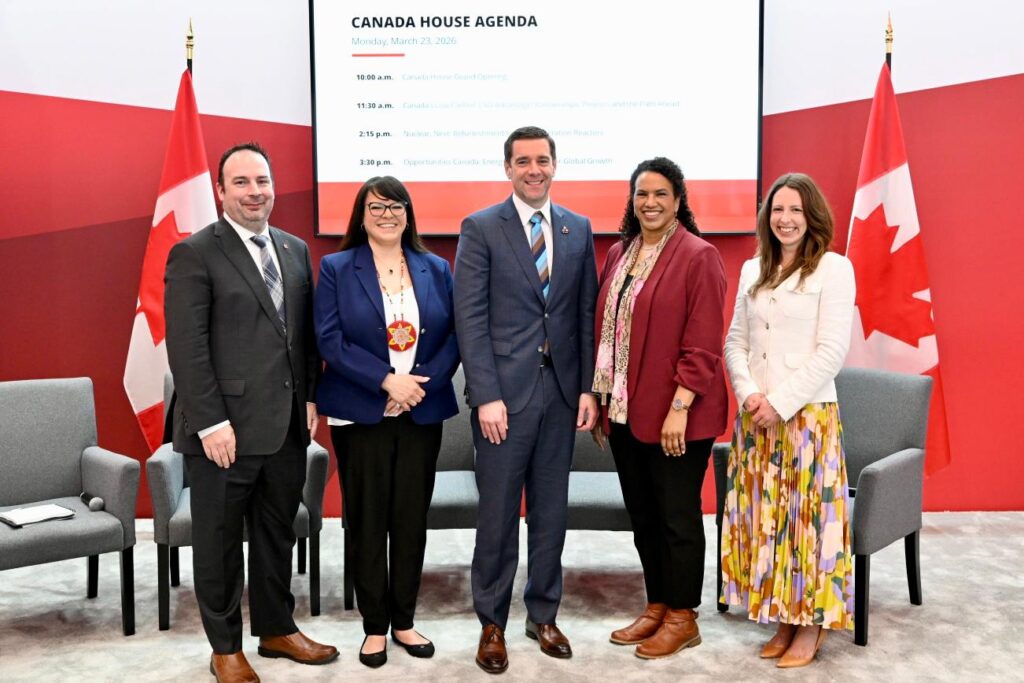
Industry leaders Scott Volk and Trevor Ebl highlighted the significant progress Canada has made in delivering major energy infrastructure, including LNG Canada Phase 1 and the Coastal GasLink pipeline. These projects represent a pivotal milestone—firmly placing Canada on the map as a reliable LNG producer and exporter. Their discussion emphasized not only technical and operational success, but also the strong collaboration with First Nations stakeholders that brought these projects to completion.
A central theme throughout the discussion was the importance of partnership with First Nations. The panelists underscored that collaboration with Indigenous communities has been fundamental to project success, helping to build trust, create shared economic benefits, and ensure long-term sustainability.
Sharleen Gale reinforced this perspective, noting that the evolving model of partnership between Indigenous nations and industry marks a new chapter for Canada’s energy sector. This approach fosters greater certainty, shared ownership, and a collective commitment to success, sending a strong signal to investors and global markets.
ESF Chair, Shannon Joseph spoke to the shifting global energy landscape and the growing demand for supply diversification. Even prior to recent geopolitical instability, many countries were actively seeking to reduce reliance on a limited number of energy suppliers. Recent developments, specifically the conflicts in the Middle East and Ukraine, have only accelerated this trend.
Against this backdrop, Canada is uniquely positioned to step forward as a dependable and responsible energy partner. With its reliable and abundant supply of LNG, stringent environmental standards, and demonstrated commitment to collaboration, Canada has a clear opportunity to meet global demand with responsibly produced abundant energy.


