Over the past week, Canada’s energy companies—sellers of oil, natural gas or liquefied natural gas (LNG), liquid petroleum gas (propane)—have had their phones ringing off the hook as countries urgently seek access to energy supplies from Canada.
Not only do these countries want to buy the energy, but some, like India, even want to invest in Canada to make it happen.
This was the mic-dropping message of India’s High Commissioner to Canada, His Excellency Dinesh Patnaik, when I recently spoke with him in Ottawa. It reflects a belief within India and a growing number of markets that Canada can offer resilience to conflict risk when it comes to energy and economic security.
India well knows that access to energy is among the greatest limiting factors of economic growth. As the High Commissioner put it, “Growth without energy is not possible.” Today, India is about 60 percent energy self-sufficient thanks to its coal reserves and solar resources. But it imports close to 90 percent of its oil and natural gas, the latter of which is meant to play a significant role in reducing the emissions intensity of its power sector. Today, most of that oil and gas comes to India from the Middle East.
It was during Prime Minister Carney’s visit to India that the United States and Israel led an attack on the regime of Ayatollah Ali Khamenei in Iran, plunging the region and the critical Strait of Hormuz into a conflict that has lasted six weeks so far. Because of the war, the petroleum products that would normally flow through the strait—roughly one-fifth of the world’s supply—have been compromised, impacting global energy prices and security.
India’s strategic energy reserves allow it some near-term resilience, more so on oil than on natural gas, but this conflict has underscored the importance of diverse energy partners, especially ones like Canada, which have low conflict risk.
As he put it, “We would like to import from jurisdictions with whom we share values, which are reliable, and which in the long run [would enable us] to do things without passing through choke points” like Hormuz.
India is a country on the rise. With a large, relatively young population—average age 27 years old, compared to Canada’s average age of 41—the High Commissioner described India as a nation “of aspiration.”
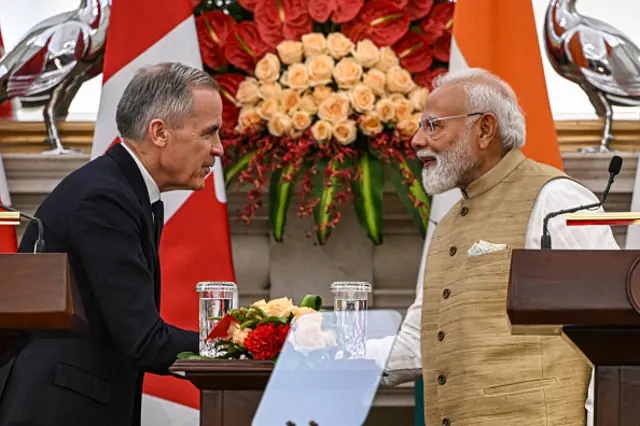
Some of these aspirations were laid out during the meeting of Prime Minister Mark Carney and Prime Minister Narendra Modi during Carney’s recent trip to India. They include doubling their import of LNG by 2030, to help address an expected doubling of energy demand between now and 2040, which, it is hoped, will fuel a GDP of $30 trillion by 2047, the 100th anniversary of Indian Independence.
For context, in 2025, India’s GDP was $4.18 trillion compared to Canada’s $2.3 trillion, with a population that is 2 percent of India’s.
Canada is an ideal supplier; we are a politically stable democracy with real respect for the environment and human rights, and with large reserves of almost every kind of energy resource.
“Canada is already an energy superpower,” he noted, while India is rapidly becoming an “energy super consumer.”
Canada’s main problem remains that we lack the infrastructure we need to expand exports, and this limits our ability to grow production.
Our limitations are the result of past decisions, but what matters now is the future we plan to build. Being an energy superpower requires big investment. India is now willing to take another chance on investing in Canada’s energy industry and investing in “upstream, midstream, downstream—the entire sector.”
This is no small thing. It represents the reversal of a trend of Canada losing capital, which has taken hold over the past 10 years. Moreover, it is a signal the world needs and is willing to pay for our responsibly produced energy as never before.
Canada will be defined by how we respond to this moment. We need to act decisively and build quickly to show that the trust India and others are placing in us is deserved. With international commitments made, Canadian companies in dialogue with potential customers and notable domestic tools like the Alberta and Federal Indigenous loan guarantee programs—there should be nothing holding us back.
Perhaps the High Commissioner’s most compelling message was directed not at policymakers, but to Canadians themselves: “You are sitting on some of the resources which the world needs…. Be proud of your resources, and [make] them available to the world. [By selling them abroad,] you will be doing a great favour to the whole world.”


