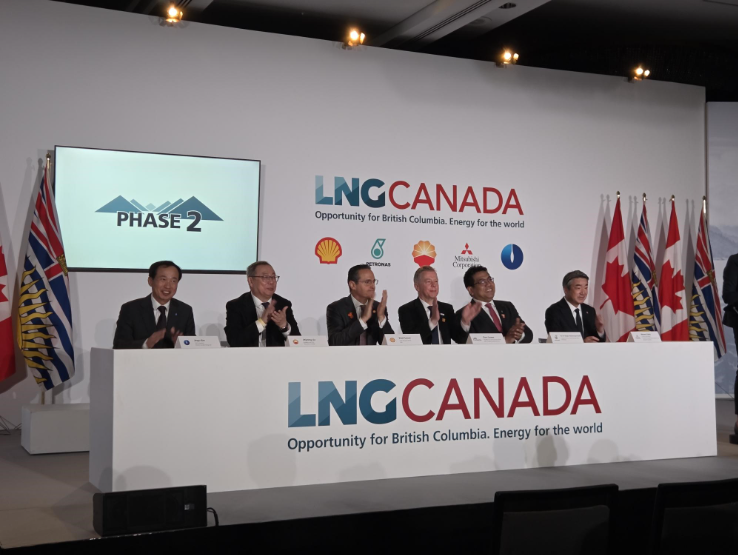
Joint Venture Partners at Phase two announcement – Jingu Kim, KOGAS Canada; Zhiyong Liu, PetroChina LTD; Wael Sawan, Shell Plc, Chris Cooper, LNG Canada; Tan Sri Tengku Muhammad Taufik, Petronas; Masaru Saito, Mitsubishi
I was pleased to take part in the official announcement of the LNG Canada Phase 2 final investment decision on behalf of Energy for a Secure Future (ESF). This decision by the five international joint venture partners to expand the Kitimat, B.C., LNG export facility will grow Canada’s standing as a global energy security partner at a critical time. It also marks an important milestone in Canada’s ability to attract the international investment we need to build major projects.
Since 2022, countries in Europe and Asia have called on Canada to supply more LNG globally as these nations sought to diversify their energy supplies away from Russia. These calls have grown louder in 2026 amid the instability and disruptions to energy flows caused by the conflict in the Strait of Hormuz.
LNG Canada Phase 1 put Canada on the map as a global LNG supplier and demonstrated that we can deliver our energy to countries that need it. Phase 2 allows us to build on that foundation, to get greater access and value for our resources, and to create long-term opportunities for Canadians. This is a truly a historic moment for Canada.
Our friends at Canada’s Build Trade Unions were well represented at the event with leadership from the North American, Canadian and BC branches. Despite the reporting by many outlets, the jobs story for this project is important for a number of reasons:
The over 75,000 construction jobs and the experience it gave Canadian workers that can be deployed on future projects, including Phase 2.
The over 400 staff currently operating the Phase I facility with the expectation of an additional 90 permanent and 150 contractor roles one Phase 2 is complete.
The 81,000 direct, indirect and induced jobs associated with the long-term growth of the upstream natural gas sector, which, without market access would have been in decline.
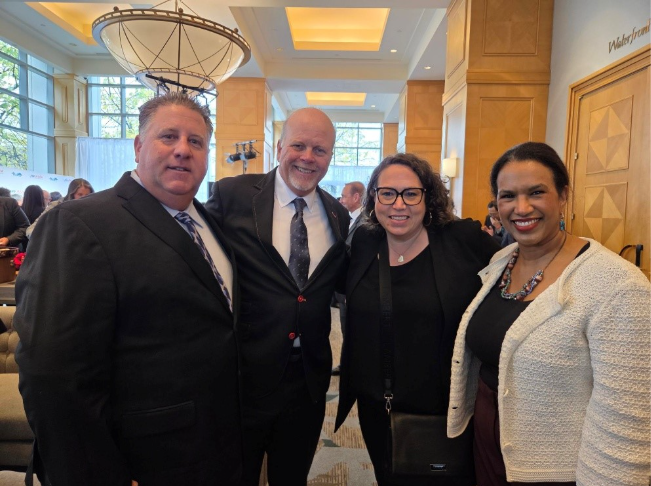
Building Trades Leaders Al Phillips, Sean Strickland and Brynn Bourke at the LNG Canada Phase 2 announcement along with ESF Chair Shannon Joseph
The skills that workers will be able to builds and credentials they will be able to take anywhere were built through the experience of building such a major project. Building up people through higher incomes and greater skill and experience is a top line of the LNG story.
The other top line is Canada taking its place on the world stage as a global LNG supplier at a time when importing countries are aggressively seeking supply diversification to manage conflict risks. This past summer the leaders statement from the Group of 7 (G7) specifically called out the role of Canada:
“We commit to accelerate the diversification of energy supply routes in order to reduce global vulnerability to the Strait of Hormuz and to increase our energy stocks. We welcome the potential for Canada to deliver significant additional capacity to global markets in the coming years.”
Canada needs infrastructure to deliver that additional capacity and LNG Canada Phase 2 is a critical part of this. Phase 2 will double LNG Canada’s export capacity from approximately 14 million tonnes per year to 28 million tonnes. For context, this is about a third of the 80 million tonnes that are normally shipped through the Strait of Hormuz. The ability to move more volumes means the ability to be the reliable supplier our allies are seeking.
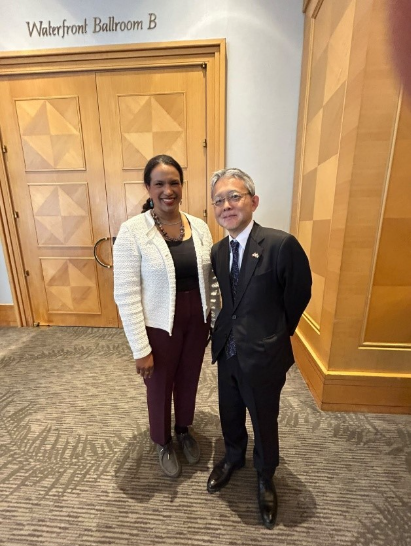
ESF Chair Shannon Joseph meets His Excellency Masashi Nakagome, Ambassador of Japan to Canada, Japan imports 98% of its natural gas, which provides roughly one third of its electricity
The expansion of LNG Canada represents approximately $33 billion in new private-sector investment in Canada. We needed foreign direct investment to make this project possible; this is something Canadians often don’t appreciate. Canada does NOT have all the capital it needs to build these major projects. Treating foreign investors well and celebrating them for taking a chance on Canada is vitally important.
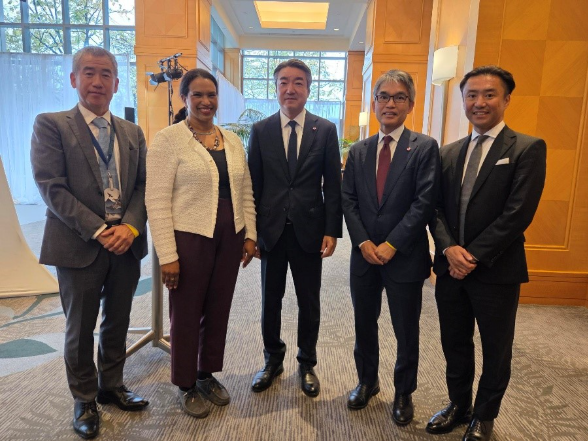
ESF Chair with Mitsubishi Team including Group CEO, Energy & Power Solution Masaru Saito (centre) and Kentaro Toyokawa (furthest right), CEO of Diamond Gas Management Canada
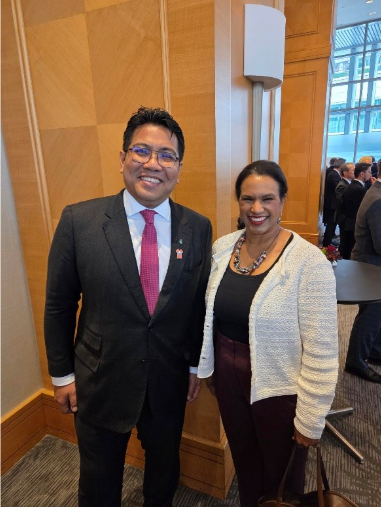
ESF Chair with Tan Sri Tengku Muhammad Taufik President and Group CEO, PETRONAS
This global investment creates lasting local benefits as we described in the recent ESF Report When Our Nation Builds. These benefits include employment and workforce development, business opportunities, government revenues and increased own-source revenues for First Nations in the project corridor between Northeast BC and Kitimat. This latter element is worth paying attention to.
There are many layers of partnership with First Nations associated with LNG Canada, TC Energy’s Coastal Gaslink pipeline that supplies it and the upstream Montney natural gas production. The most recent of these includes the up to $1-billion potential equity stake in an LNG Canada Phase 2 storage tank for five local First Nations – the Haisla Nation, Gitga’at Nation, Gitxaała Nation, Kitselas First Nation and Kitsumkalum First Nation. Chief Maureen spoke to the importance of this partnership in her remarks on stage.
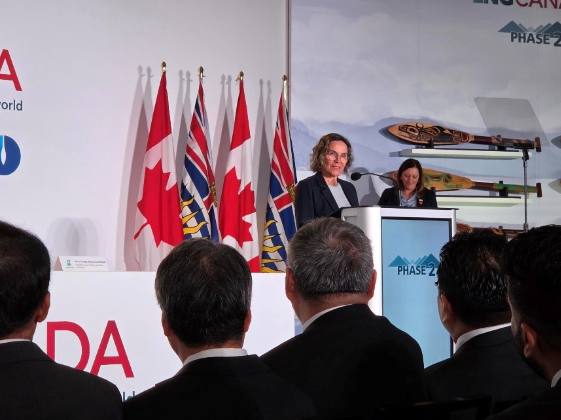
Chief Councillor Maureen Nyce on stage at the announcement of LNG Canada Phase 2
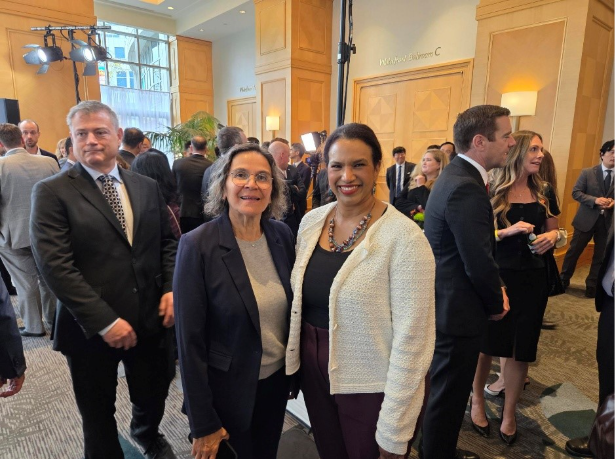
Chief Councillor Maureen Nyce, Haisla Nation and ESF Chair at LNG Canada Phase 2 reception
Our research found that between 2019 and 2023 the First Nations along the LNG Canada/Coastal Gaslink corridor saw their revenues increase 159%. This was before sixteen of the twenty nations exercised their 10% equity option in Coastal Gaslink. These additional revenues, that belong to the nations without reference to Ottawa had come to represent 36% of First Nations operating budgets and put towards education, local economic development and other programs. These real and growing benefits are part of how First Nations are establishing the tools for a new and more positive future for their members. It was exciting to see present both the new leaders carrying this forward and leaders who came before and took the risks that made today possible – including Karen Ogen, CEO of the First Nations Nation Gas Alliance and former Chief of the Wet’suwet’en First Nation and Crystal Smith, former Chief Councillor of Haisla Nation and current ESF Senior Fellow.
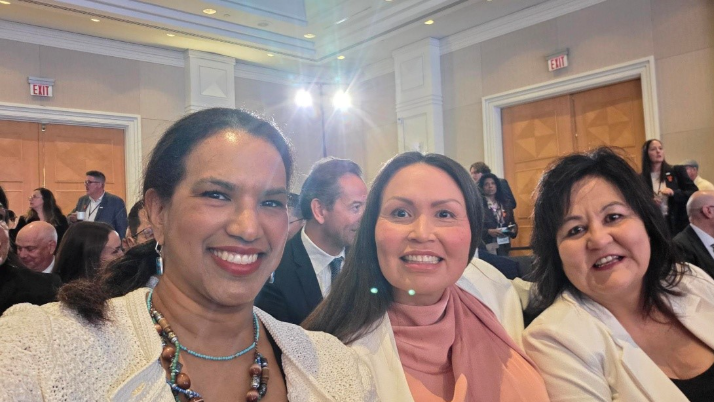
ESF Chair Shannon Joseph alongside Crystal Smith and Karen Ogen
What may British Columbians look forward to as a result of LNG Canada Phase 2?
In Part 3 of When Our Nation Builds, iTotem Analytics conducted an analysis of three scenarios – if we never build LNG Canada and Coastal Gaslink, if we only build LNG Canada Phase I and if we went on to build LNG Canada Phase 2, completed Cedar LNG and build the Ksi Lisims LNG project.
The analysis shows social progress for the 20 municipalities and 20 First Nations in the project corridor on an improved trajectory from 2021 to 2031 as we build more: with higher household incomes, more affordable housing, more education being completed and recovery of Indigenous language.
Part 4 of the report examines how upstream natural gas production can grow by having market access, driving permanent jobs and the largest source of royalties to the province of British Columbia – more than the next three resource sectors combined. For a province looking to growth its economy and global trade, this is important for everyone – both in the region and beyond.
So my closing thoughts: Let’s celebrate this moment and let’s keep going.