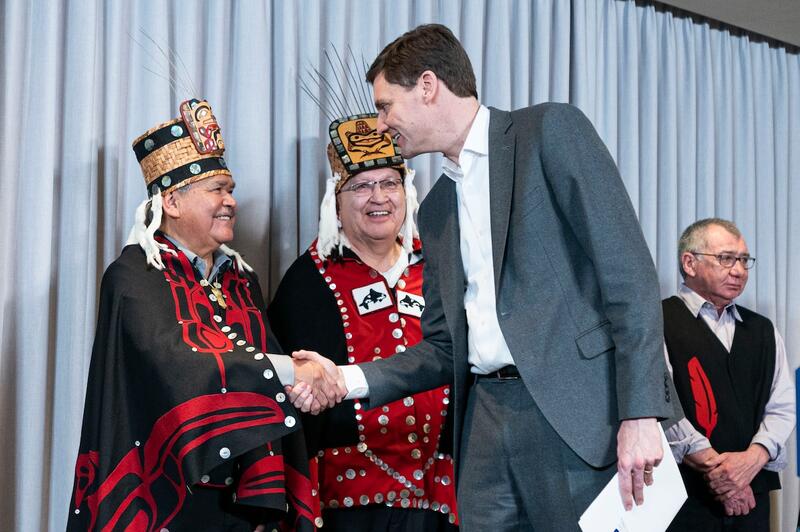
This weekend, Mark Carney will travel to Japan for a bilateral summit with Japanese Prime Minister Sanae Takaichi, part of his ongoing Indo-Pacific tour. Talks will centre on bolstering economic ties and strategic cooperation between our two nations, and energy will be a major topic of discussion.
As it happens, we’ve both travelled to Japan in recent years to take part in missions organized by Energy for a Secure Future (ESF), a non-partisan Canadian advocacy group that brings together Canadian business leaders, Indigenous peoples and other stakeholders to promote a secure and reliable energy future for Canada and its global allies. Our aim was to strengthen Canada’s role as a trusted energy partner to Japan and to connect Indigenous leaders involved in resource development with their international customers. The most recent mission was just two weeks ago.
Throughout these trips, people have expressed great interest in the Indigenous element of resource projects in Canada and what they perceived as a new message. They had been led to believe that First Nations communities in Canada were uniformly opposed to resource development, leading them to question whether Canada could become a reliable long-term supplier of energy to Asian markets. They told us they were honoured to meet with representatives of First Nations in the regions where energy development was taking place, and to learn not only of their support, but of their active role in making these projects successful.
This work of global outreach and dialogue is something Indigenous leaders, alongside their partners in industry, are doing more and more. From the co-authors’ engagement with the Group of 7 Ambassador in Ottawa, to COP28 in Dubai, and missions to China and Japan, to the participation of First Nations, Metis and Inuit Peoples in Canada’s missions to Asia and Europe, there is a new message for the world. Partnership in Canada is the foundation for Canada being a better partner to our allies around the world.
International misconceptions, it must be said, have their foundation in fact. Too often in Canada’s history, Indigenous Peoples have been made to bear the cost of these major projects, while being denied their benefits.
In the past decade, however, that has changed significantly. In that time, the resource sector, along with Canada’s legal regime, has evolved to both recognize the rights of Indigenous Peoples to be consulted on the use of their traditional lands and to emphasize the importance of First Nations having a share and a say in natural resource projects. In the energy sector, there are a growing number of examples of a new way of working and cooperating.
In this new environment, it has become increasingly clear that, contrary to the stereotype, a critical mass of Indigenous nations in Canada are not opposed to resource development. That fact has been driven home in successful partnerships, including Suncor’s East Tank Farm, Enbridge’s West Coast natural gas pipeline system, the Coastal Gaslink Pipeline equity option, the Cedar LNG project, the Cascade Power project, and more.
As First Nations’ equity in these projects increases, they are as desirous as anyone to see them succeed, for the good of all partners and for Canada itself.
One conversation from the most recent trip to Japan underscored this final point. First Nations Major Projects Coalition CEO Mark Podlasly, while emphasizing the importance of First Nations having “a seat at the table,” said, “We as Indigenous people are also Canadian, and the way our rights are currently defined is tied to the existence of Canada. So, we are all in this together.”
It is a powerful point and speaks to the shared identity that can arise through reconciliation and partnership, and what this can mean for Canada as an energy ally on the international stage, especially in this uncertain moment.We live in a moment where trade tensions are on the rise. The global energy situation is increasingly precarious, with the wars in Ukraine and Iran restricting the flow or supply of oil and natural gas. Meanwhile, global demand for these energy sources is only increasing, particularly with the rise of data centres and their need for 99.995 percent reliable electricity, consuming more and more energy.
Amid these pressures, Indigenous nations are taking to the world stage to share their vision for responsible resource development, while standing shoulder-to-shoulder, as fellow Canadians, with business partners, and federal and provincial government representatives to make the case for what Canada has to offer.
So, as the prime minister arrives in Tokyo, it is our sincere hope that our and others’ missions will have laid the groundwork for some productive talks about energy security and the role that Canadian hydrocarbons can play in meeting their needs, for the good of the people of Japan and all Canadians.
After all, we’re in this together.


